How Broker Evaluation Platforms Use BaFin Data: The Framework Behind Independent Analysis
Independent Broker Evaluation: The Transparent Framework
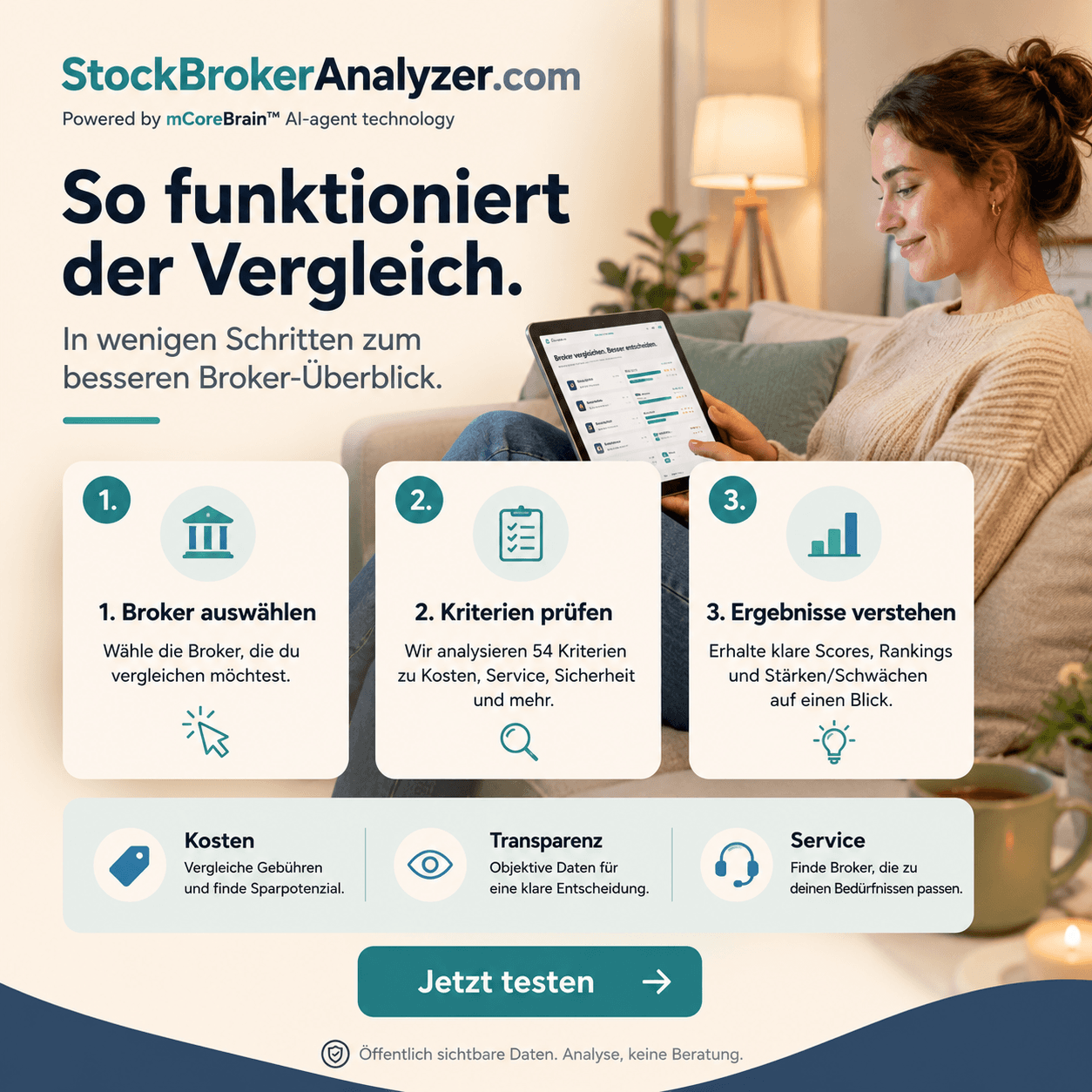
When you compare online brokers, you're often comparing them against published criteria — standardized measures applied consistently across every platform. StockBrokerAnalyzer.com uses structured, publicly available criteria to evaluate brokers. But what does that actually mean, and how does it differ from picking a broker based on marketing claims or feature checklists?
How Evaluation Frameworks Work
A criteria-based evaluation platform assesses brokers across specific, measurable categories — for example, regulatory authorization status, compliance history, account protection mechanisms, fee transparency, and execution quality. Each criterion is either verifiable from public sources or provable through hands-on testing. The platform applies the same ruleset to every broker, every time, so the results are repeatable and comparable.
For German investors, the foundation of this evaluation begins with BaFin's Database of companies, where banks, financial services providers, asset management companies, insurers or pension funds must hold written authorisation before commencing operations. A broker's authorization status, license type, and authorized activities are the first verifiable facts. From there, evaluation platforms typically layer in additional criteria: whether the broker segregates customer funds, what regulatory disclosures it publishes, how clearly it discloses fees and execution quality, and whether it maintains adequate capital reserves.
Regulatory Transparency as the Backbone
Much of broker evaluation depends on transparency that regulators already require. MiFID II requires investment firms who execute client orders to summarise and make public on an annual basis, for each class of financial instruments the top five execution venues in terms of trading volumes where they executed client orders in the preceding year and information on the quality of execution obtained. These disclosures — though originally intended to serve professional investors — are equally accessible to retail investors and to evaluation platforms.
Similarly, the statutory deposit guarantee schemes protect balances of up to €100,000 per customer and bank in Germany. Whether a broker's banking partner participates in this scheme, and at what coverage level, is public information that evaluation platforms verify against official sources.
Distinguishing Between Evaluation and Recommendation
It's important to understand that criteria-based evaluation is not the same as ranking for the purpose of recommendation. A platform can report that Broker A scores higher on execution quality than Broker B without recommending Broker A to every investor. Why? Because the "right" broker depends on your priorities — an active day trader cares about execution latency and order routing transparency, while a long-term pension saver prioritizes fee simplicity and account protection features.
StockBrokerAnalyzer's evaluation framework reveals patterns: which criteria matter most for regulatory compliance, which brokers have consistent weaknesses, and where the brokerage industry as a whole tends to fall short. This analysis informs investors without directing them toward a specific choice.
Verification and Updates
Broker licensing, fee structures, and regulatory status change. A rigorous evaluation platform must re-verify its data regularly — not once annually, but continuously. Broker evaluation scores shift weekly due to regulatory filings, fee adjustments, and platform changes. Learn what moves the needle and why re-verification matters. New BaFin enforcement actions, updated MiFID II disclosures, or a change in deposit protection membership all affect the factual basis for evaluation.
Using Evaluation Frameworks Yourself
Understanding how evaluation platforms work gives you tools to verify brokers independently. Start with official sources: check BaFin's Database of companies to confirm authorization. Review the broker's published MiFID II disclosures on execution quality. Verify its deposit protection coverage. Compare fee disclosures side by side. None of this requires trusting a third-party platform — it's all publicly available.
Evaluation platforms accelerate this process by standardizing the research, applying consistent criteria, and flagging discrepancies you might otherwise miss. But the underlying data is always public, always verifiable, and always accessible to any investor willing to spend time on independent research.
Sources
- BaFin: Search companies database
- German statutory deposit guarantee scheme (BaFin)
- MiFID II best execution requirements (Planet Compliance)
Analysis, not investment advice.